
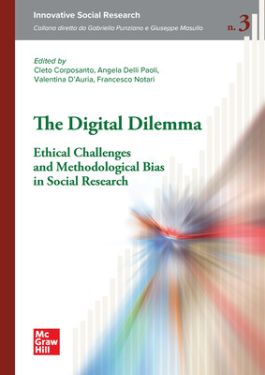
THE DIGITAL DILEMMA
1ed
8838623260
·
9788838623264
© 2025 | Data di Pubblicazione: 10 Dicembre 2025
In an age where digital traces permeate every sphere of social life, research practices increasingly rely on data that are neither elicited nor designed but spontaneously produced through interactions within socio-technical systems. These innovations…
Continua a leggere
Chapter 1 Ethics and Al: challenges and principles
Chapter 2 The AI Dilemma in Healthcare: Towards the Multidimensional AI Literacy Framework
Chapter 3 Artificial Intelligence Applications to Analyse Communication Strategies in Oncology Fundraising Campaigns: A study on the 5x1000 campaigns of the Scientific Institutes for Hospitalization and Care (IRCCS) in Italy
Chapter 4 Digital Technologies and Value Co-creation in Public Policies: Public Service Logic in the perspective of Al innovation
Chapter 5 How Al Will Transform Epistemology and Praxis of Social Theory and Research
Chapter 6 Ethical considerations in the use of artificial intelligence for image generation and art
Chapter 7 Slower, deeper, gentler
Chapter 8 From the DESI index to the creation of DESICAM: A new paradigm for digital
Chapter 9 Being a camorrist: narratives and self-representation of the Bari camorra on TikTok
Chapter 10 Manifestations of digital deviance between possibility of repression and freedom of expression
Chapter 11 Service Learning and Social Research: Challenges and Opportunities
Chapter 12 Utilizing Spatial Content in Social Research: Methods, Possibilities, and Obstacles
Chapter 13 Understanding Cyberbullying in the Alpha Generation: a Qualitative Study on Pre-adolescents
Chapter 14 Not just data, but everyday lives: Rethinking the ordinary in digital contexts
Chapter 15 What is the role of men’s issue? Ethical dilemmas and new communicative opportunities
Chapter 16 Investigating the forms of reproduction of gender inequality on TikTok through a qualitative approach: the case study, the “malessere” phenomenon
Chapter 17 Youth sport: a web survey on family sport culture in Italy
Chapter 18 New spaces of influ-activism: netnographic investigation of TikTok and Twitch communities
Chapter 19 When being a mother becomes a choice. New meanings and forms of legitimation of the Childfree subculture in digital
Chapter 20 Living in the Age of Algorithmic Uncertainty: Trust, Risk, and Reputation in the Digital Society
Chapter 21 Responding to an emergency: the bradyseismic phenomenon and “Quelli della zona rossa”
Chapter 22 Digital Society and Labor Market: A Mixed Methods Analysis in Five Departments of the University of Naples Federico II
Chapter 23 Impact of “Cucine da Incubo” on Restaurant Reviews: A Mixed Methods Analysis
Chapter 24 The digital narratives of the Quartieri Spagnoli in Naples. An integrated research
Chapter 25 Integrating Node Features and Structure: Distance Measures in Social Network Comparison
Chapter 26 How to Choose a Car Ride. A Digital Experimental Approach to Investigate the Role of Authority and Trust in BlaBlaCar’s User Decision-Making
Chapter 2 The AI Dilemma in Healthcare: Towards the Multidimensional AI Literacy Framework
Chapter 3 Artificial Intelligence Applications to Analyse Communication Strategies in Oncology Fundraising Campaigns: A study on the 5x1000 campaigns of the Scientific Institutes for Hospitalization and Care (IRCCS) in Italy
Chapter 4 Digital Technologies and Value Co-creation in Public Policies: Public Service Logic in the perspective of Al innovation
Chapter 5 How Al Will Transform Epistemology and Praxis of Social Theory and Research
Chapter 6 Ethical considerations in the use of artificial intelligence for image generation and art
Chapter 7 Slower, deeper, gentler
Chapter 8 From the DESI index to the creation of DESICAM: A new paradigm for digital
Chapter 9 Being a camorrist: narratives and self-representation of the Bari camorra on TikTok
Chapter 10 Manifestations of digital deviance between possibility of repression and freedom of expression
Chapter 11 Service Learning and Social Research: Challenges and Opportunities
Chapter 12 Utilizing Spatial Content in Social Research: Methods, Possibilities, and Obstacles
Chapter 13 Understanding Cyberbullying in the Alpha Generation: a Qualitative Study on Pre-adolescents
Chapter 14 Not just data, but everyday lives: Rethinking the ordinary in digital contexts
Chapter 15 What is the role of men’s issue? Ethical dilemmas and new communicative opportunities
Chapter 16 Investigating the forms of reproduction of gender inequality on TikTok through a qualitative approach: the case study, the “malessere” phenomenon
Chapter 17 Youth sport: a web survey on family sport culture in Italy
Chapter 18 New spaces of influ-activism: netnographic investigation of TikTok and Twitch communities
Chapter 19 When being a mother becomes a choice. New meanings and forms of legitimation of the Childfree subculture in digital
Chapter 20 Living in the Age of Algorithmic Uncertainty: Trust, Risk, and Reputation in the Digital Society
Chapter 21 Responding to an emergency: the bradyseismic phenomenon and “Quelli della zona rossa”
Chapter 22 Digital Society and Labor Market: A Mixed Methods Analysis in Five Departments of the University of Naples Federico II
Chapter 23 Impact of “Cucine da Incubo” on Restaurant Reviews: A Mixed Methods Analysis
Chapter 24 The digital narratives of the Quartieri Spagnoli in Naples. An integrated research
Chapter 25 Integrating Node Features and Structure: Distance Measures in Social Network Comparison
Chapter 26 How to Choose a Car Ride. A Digital Experimental Approach to Investigate the Role of Authority and Trust in BlaBlaCar’s User Decision-Making
In an age where digital traces permeate every sphere of social life, research practices increasingly rely on data that are neither elicited nor designed but spontaneously produced through interactions within socio-technical systems. These innovations open unprecedented opportunities for social inquiry while simultaneously exposing researchers to new epistemic and ethical uncertainties. The abundance of digital information challenges conventional approaches to sampling, validity, and interpretation, as the availability of data often precedes theoretical formulation and drives methodological choices. This new digital environment blurs the boundaries between what is public and private, accessible and legitimate, raising questions of privacy, consent, and responsibility that existing ethical frameworks struggle to address. At the same time, algorithmic mechanisms, platform logics, and self- resentation strategies generate subtle yet pervasive forms of bias that reshape the trustworthiness and representativeness of research outcomes. Bringing together diverse theoretical reflections and empirical case studies, this volume explores the complex interplay between methodological innovation and ethical responsibility in digital social research. It aims to provide scholars and practitioners with critical insights into the dilemmas, biases, and promises of conducting research in a world increasingly mediated by data and algorithms.