
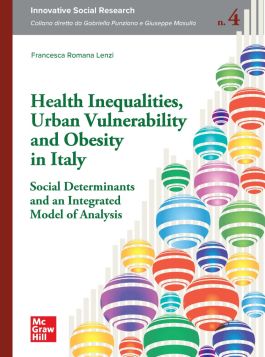
HEALTH INEQUALITY, URBAN VULNERABILITY AND OBESITY IN ITALY
1ed
883862545X
·
9788838625459
© 2026 | Data di Pubblicazione: 20 Giugno 2026
Why does obesity follow the fault lines of social inequality? Why do people who know exactly what they should eat so often fail to eat accordingly? And why does the neighbourhood you live in shape your chances of developing a chronic disease as power…
Continua a leggere
Chapter 1 Vulnerability, Quality of Life, and Social Inequalities in Health - Francesca Romana Lenzi, Ferdinando Iazzetta
Chapter 2 Urban Vulnerability and Health Inequalities in Italian Cities: An Ecological Approach - Ciro Clemente De Falco, Ferdinando Iazzetta, Francesca Romana Lenzi
Chapter 3 Obesity as a Social Fact: The SIDERALE Project - Michela Cavagnuolo, Vincenzo Esposito, Francesca Romana Lenzi
Chapter 4 Food Practices and Social Determinants: The Dietary Fructose Project - Ciro Clemente De Falco, Francesca Romana Lenzi, Michela Cavagnuolo
Conclusions Towards an Integrated Model for the Analysis of Obesity and Other NCDs - Francesca Romana Lenzi
Chapter 2 Urban Vulnerability and Health Inequalities in Italian Cities: An Ecological Approach - Ciro Clemente De Falco, Ferdinando Iazzetta, Francesca Romana Lenzi
Chapter 3 Obesity as a Social Fact: The SIDERALE Project - Michela Cavagnuolo, Vincenzo Esposito, Francesca Romana Lenzi
Chapter 4 Food Practices and Social Determinants: The Dietary Fructose Project - Ciro Clemente De Falco, Francesca Romana Lenzi, Michela Cavagnuolo
Conclusions Towards an Integrated Model for the Analysis of Obesity and Other NCDs - Francesca Romana Lenzi
Why does obesity follow the fault lines of social inequality? Why do people who know exactly what they should eat so often fail to eat accordingly? And why does the neighbourhood you live in shape your chances of developing a chronic disease as powerfully as your genes? This book argues that obesity — one of the most consequential public health challenges of our time — cannot be understood through a biomedical lens alone. Drawing on two original research projects conducted across five Italian cities (Bari, Naples, Novara, Pisa, and Rome), it shows how social stratification, urban environments, cultural norms, and territorial inequalities combine to produce the unequal distribution of obesity we observe in contemporary Italy. The SIDERALE Project reveals that vulnerability to disease is not only measurable through clinical markers, but lived through stigma, fatigue, care burdens, and the everyday constraints that make self-care structurally difficult. The Dietary Fructose Project uncovers a persistent gap between nutritional knowledge and dietary practice — and identifies a blind spot at its heart: the widespread misclassification of fruit-based sugars as nutritionally safe, a gap that persists across clinical populations and the general public alike. Together, these findings advance a new conceptual framework. Vulnerability must be understood as both measured and lived. Nutritional awareness must be understood as both declared and practised. And obesity itself must be understood as a socially embedded condition — produced not by individual failure, but by the unequal conditions in which people live, eat, and care for themselves and their families. Combining sociological theory, social epidemiology, urban studies, and original mixed-methods research, this volume offers an accessible account of what it means to take social inequality seriously in the study of chronic disease. It speaks to researchers, public health professionals, clinicians, and policymakers who believe that effective responses to obesity require not only medical knowledge, but structural change.
Francesca Romana Lenzi is a Professor of General Sociology at the University of Rome "Foro Italico." She teaches the sociology of health, urban health, and social research methodology. She serves on the PhD Board in European History and Cultures and the national Peace Studies PhD Board at Sapienza University of Rome, and she serves as Rector Delegate for Gender and Social Policies. Lenzi has published more than 100 works on the social determinants of health, urban vulnerability, food practices, social identities, and inequalities.
Francesca Romana Lenzi is a Professor of General Sociology at the University of Rome "Foro Italico." She teaches the sociology of health, urban health, and social research methodology. She serves on the PhD Board in European History and Cultures and the national Peace Studies PhD Board at Sapienza University of Rome, and she serves as Rector Delegate for Gender and Social Policies. Lenzi has published more than 100 works on the social determinants of health, urban vulnerability, food practices, social identities, and inequalities.